VITALS for Teams
See the team more clearly.
Understand how people see themselves, how they experience one another, and what patterns shape the team as a whole. Turn those insights into better conversations, stronger collaboration, and more intentional development.
Start with one team, project group, or leadership cohort.

From Self to System
Understand the person, the relationship, and the group.
Team dynamics do not come from a single average or one personality type. They emerge from the people involved, how they experience one another, and the patterns that form when they work together.
Self
VITALS Profile + VITALS 360
Deeply understand yourself then observe the gaps between those insights and the perceptions of those around you
Relationships
Profile Comparison
Understand how two people with different personalities may communicate, make decisions, participate, and work differently.
Group
Team Visualizations
See distributions and patterns across a team, department, or organization. Understand how these dynamics play out in certian situations
Each level answers a different question. Together, they create a more complete view of the team.
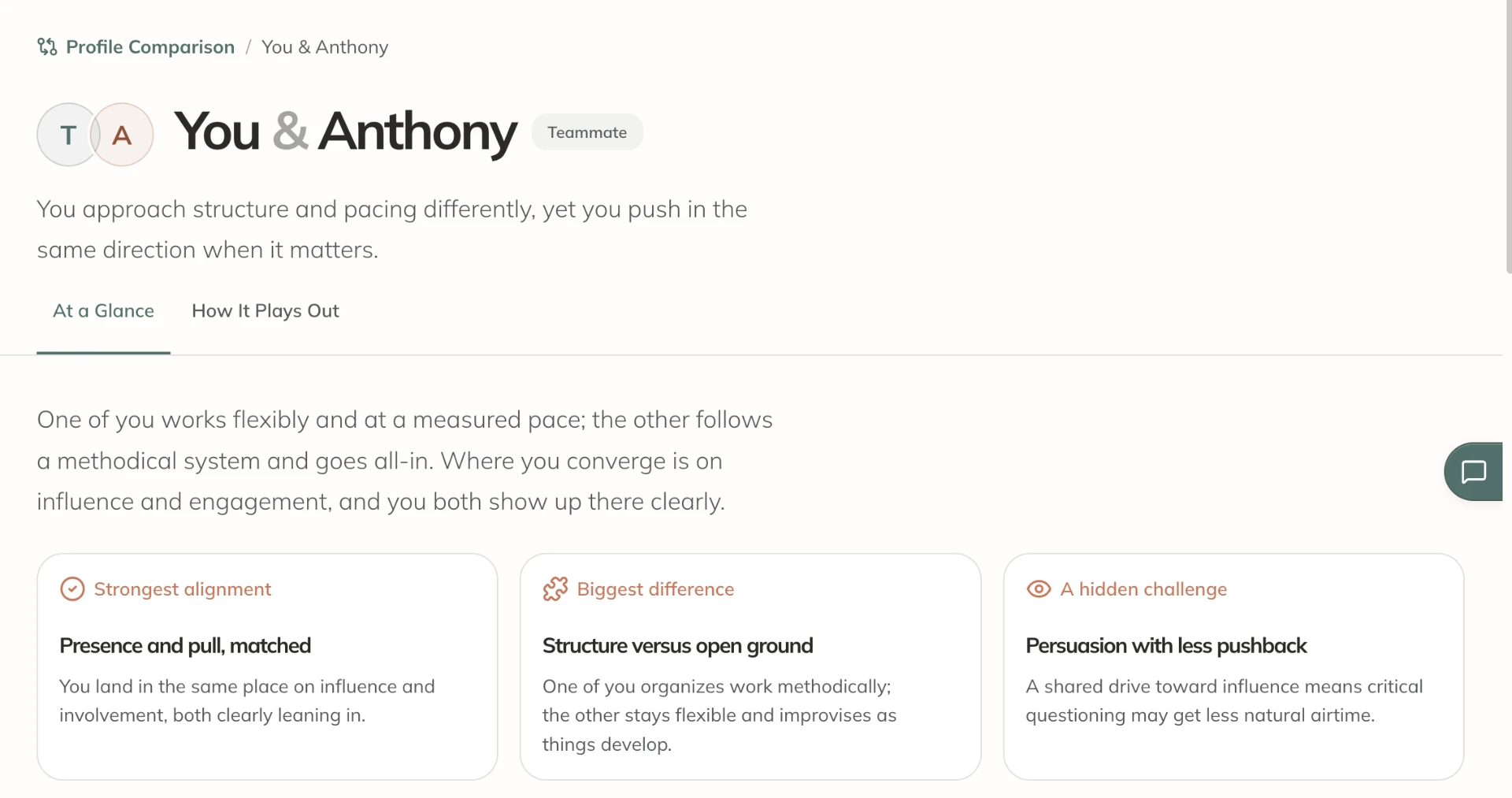
Profile Comparison
Two profiles, one working relationship.
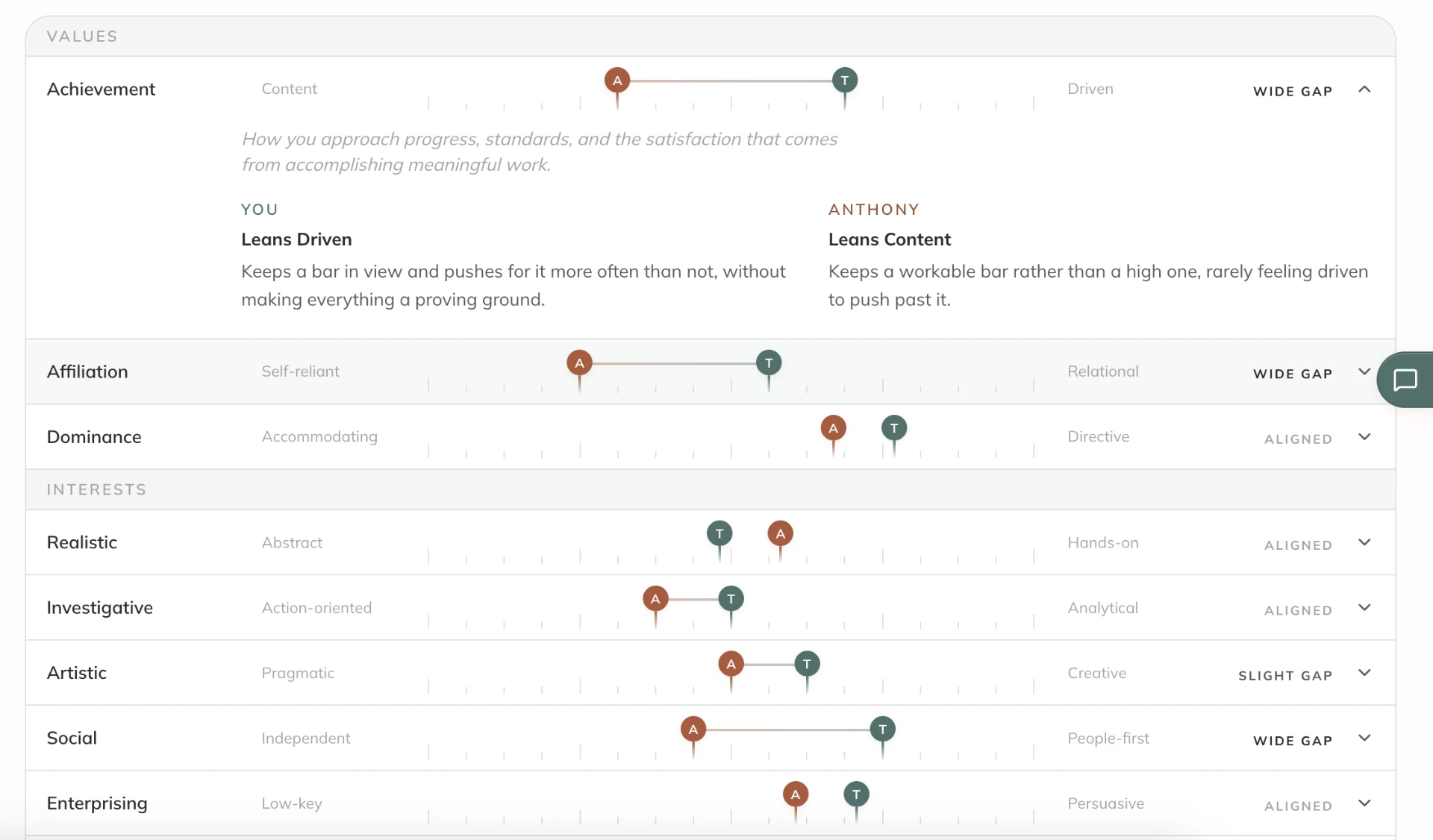
Profile Comparison helps coworkers, managers, and direct reports see where their natural approaches align, complement each other, or may require more explicit communication.
SEE YOURSELF FROM MORE THAN ONE ANGLE
Find the gaps between intention and impact.
VITALS 360 helps someone compare their own understanding of how they show up with the perspectives of people who experience them in different settings. The goal is not to produce a performance score. It is to uncover meaningful gaps, confirmations, and questions worth exploring.
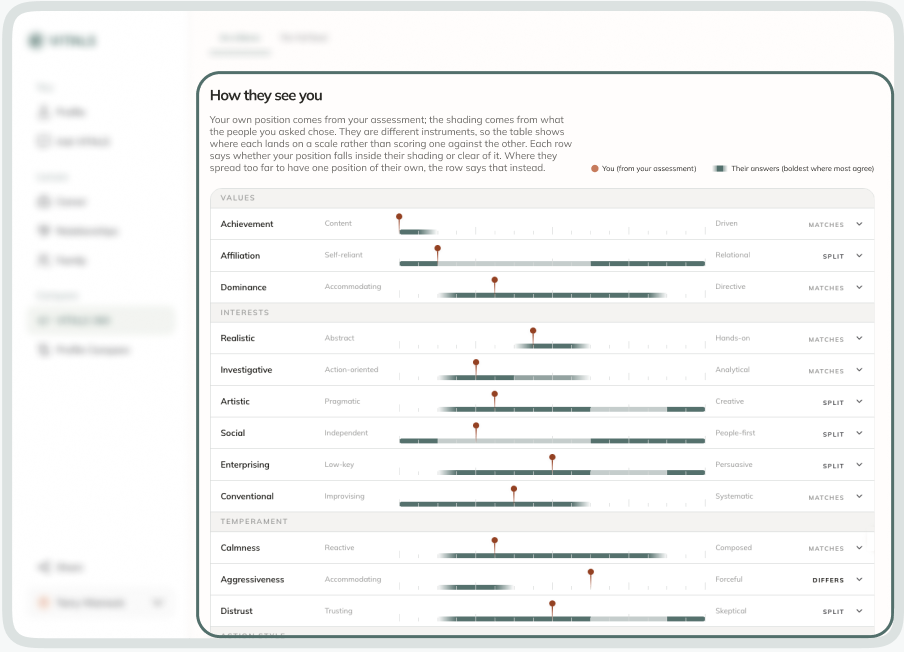
At a Glance
One row for every scale. Your own position, the spread of their answers, and whether the two sit in the same place or apart. The whole round on one screen.
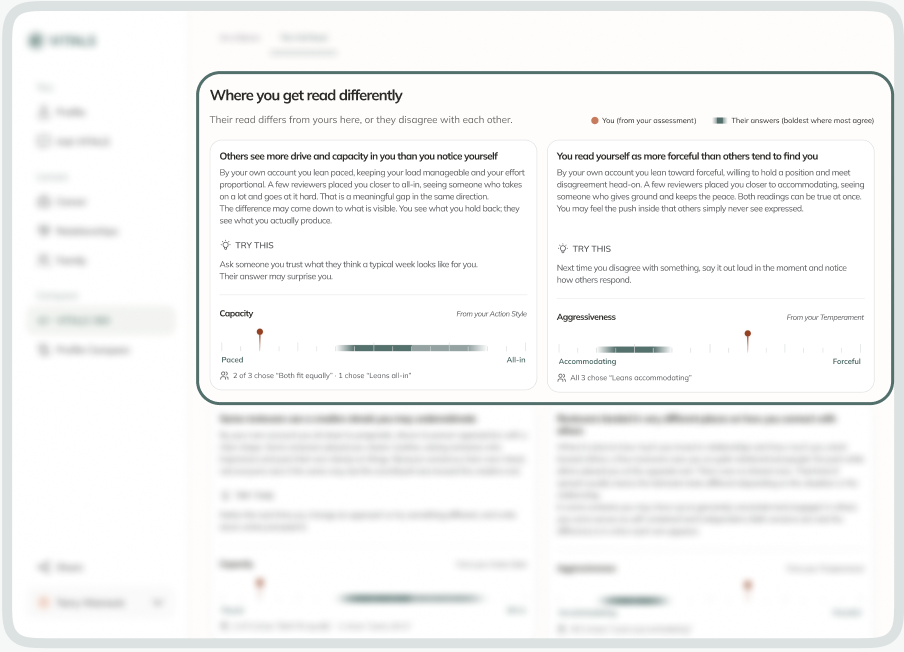
The Full Read
The detailed version. Where their read and yours land together, where they part, and what they said in their own words. Sections appear only where the answers support one.
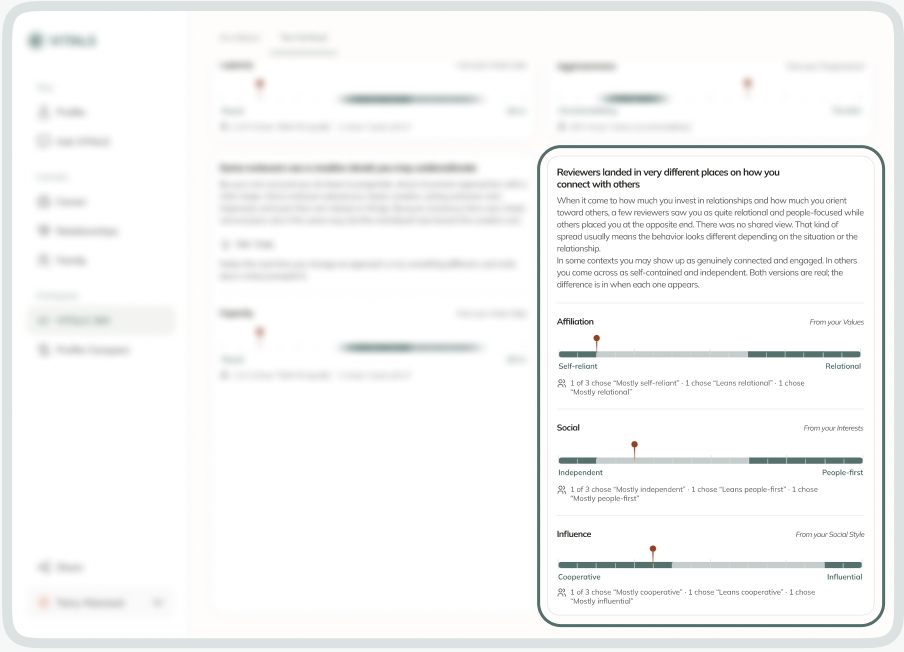
Where their answers spread
Sometimes the people answering do not agree with each other. VITALS shows that instead of averaging it away. A scale where half of them read you one way and half the other is telling you something real about how you land in different rooms.
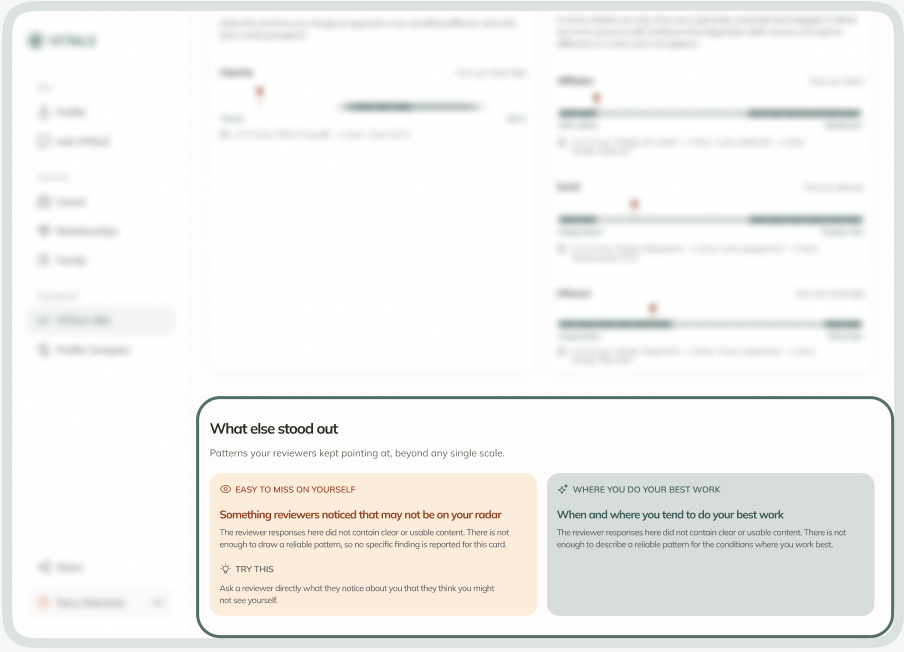
Something they see that you may not
Two open questions ask what the people answering notice in you, and where they say you do your best work. What comes back is often the part of a round people quote later.
Build With Greater Intention
See what a project team brings and what may be missing.
VITALS can help leaders consider how a potential project group approaches decisions, structure, learning, communication, and collaboration. The goal is not to create a mathematically perfect team. It is to identify patterns that may affect the work and prepare the team accordingly.
Team Interests
Working with people· Social
0Not drawn to it4Could take it or leave it10Drawn to itMost of usLeading and persuading· Enterprising
0Not drawn to it4Could take it or leave it10Drawn to itFiguring things out· Investigative
3Not drawn to it5Could take it or leave it6Drawn to itWe differHands-on work· Realistic
3Not drawn to it6Could take it or leave it5Drawn to itCreative work· Artistic
3Not drawn to it6Could take it or leave it5Drawn to itOrganizing and keeping order· Conventional
2Not drawn to it9Could take it or leave it3Drawn to itFew of us
| Interest area | Not drawn to it | Could take it or leave it | Drawn to it | Pattern |
|---|---|---|---|---|
Working with people· Social Help, teach, coach, care for people. | 0 members | 4 members | 10 members | Most of us |
Leading and persuading· Enterprising Lead, sell, start things, win people over. | 0 members | 4 members | 10 members | |
Figuring things out· Investigative Research, analyze, solve hard problems. | 3 members | 5 members | 6 members | We differ |
Hands-on work· Realistic Build, fix, grow, work with tools or outdoors. | 3 members | 6 members | 5 members | |
Creative work· Artistic Design, write, make, express ideas. | 3 members | 6 members | 5 members | |
Organizing and keeping order· Conventional Keep records, run a system, follow a process. | 2 members | 9 members | 3 members | Few of us |
ZOOM OUT
See the patterns across the whole organization.
Individual profiles can be aggregated into group-level visualizations that help leaders understand the range of tendencies across teams, departments, or the organization as a whole.
Keeps the agreement
You let others steer and you hold to what was agreed. You wait for the group to settle it.
8 of 50
Leads by the book
You take the wheel and you steer by the rules. You decide, then check it against what was promised.
7 of 50
Goes their own way, quietly
You follow your own judgment and you do not need others to follow it. You adjust on your own.
7 of 50
Makes the call
You take charge and trust your own judgment over the rulebook. You decide first and explain after.
9 of 50
On a shaded line
Clear on one question, in the middle on the other. Their dots sit on a shaded line between two corners.
12 of 50
In the center
In the middle on both questions. Their dots sit in the dark center square. They often understand every corner and can help the others understand each other.
7 of 50
Example Observation
The organization contains strong variation in how people prefer to participate. Meetings that rely only on immediate verbal contribution may miss important perspectives.
Example Action
Provide important questions before the meeting and offer more than one way to contribute.
Group patterns are conversation starters. They do not describe every individual within the group.
More Useful Reviews
Bring better context into the conversation.
VITALS can give employees and managers a shared foundation before a development or review conversation. Profile insights and 360 perspectives can help both people identify patterns, discuss gaps, and choose practical areas to work on.
Review Preparation
01
Employee Reflection
Where have my natural tendencies helped me this year?
02
360 Insight
Where might my impact differ from my intention?
03
Manager Conversation
What is one behavior or working agreement worth testing next?
Example Development Focus
Make recognition more explicit when a teammate’s contribution changes the outcome.
VITALS can inform a development conversation. It should not determine a performance rating, compensation decision, promotion, or disciplinary action.
A Stronger Start
New hires shouldn't need to guess
A new team member is learning more than a role. They are learning how the group communicates, makes decisions, handles disagreement, and gets work done.
The new employee is not expected to conform to the dominant team profile. The point is mutual understanding, in both directions.
Team Integration Guide
What This Team Tends to Value
Clear ownership and thoughtful preparation.
How the Team Communicates
Discussion is collaborative, but several members prefer time to process first.
Where the New Team Member May Add Something Different
A faster decision pace may help create momentum.
First Conversation
“What do you need from this team to do your best work—and what should we know about working with you?”
First 30-Day Agreement
Clarify decision ownership and how questions should be raised.